How Exness Pricing Engine Works
How Exness Pricing Engine Works: What Happens Before a Trade Reaches Your MT5 Platform? When traders open MetaTrader 5 and see a constantly changing bid and ask price, it is easy to assume that the price simply comes directly from “the market.” In reality, the process behind a tradable price is considerably more complex. Before […]
 Mr. JoezJuly 19, 2026 · Updated when material facts change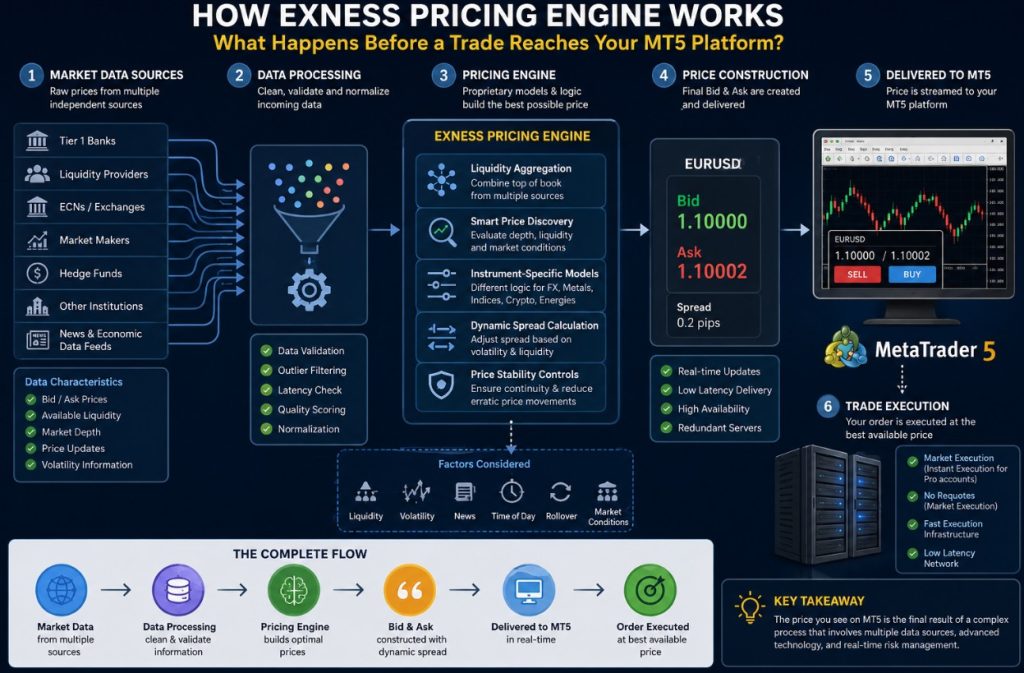
How Exness Pricing Engine Works: What Happens Before a Trade Reaches Your MT5 Platform?
When traders open MetaTrader 5 and see a constantly changing bid and ask price, it is easy to assume that the price simply comes directly from “the market.” In reality, the process behind a tradable price is considerably more complex.
Before a quote appears on your MT5 terminal, multiple layers of technology are involved. Market data must be collected, processed, evaluated, and converted into a price that can be used for trading. The system must also deal with changing liquidity, volatility, market gaps, rollover periods, and rapidly moving financial markets.
This is where a broker’s pricing infrastructure becomes important.
Exness has developed its own internal pricing and liquidity technology rather than relying exclusively on a traditional model in which a broker simply passes prices from a single external provider to its clients. According to Exness, its pricing process uses raw data from multiple independent sources and proprietary models to generate prices. The company also develops its own aggregators and pricing logic for different instruments.
So, what actually happens before a price reaches your MT5 platform?
The Simple Version: From Market Data to Your MT5 Screen
The process can be simplified into several stages:
Multiple market data sources → Data processing → Pricing models → Bid and ask calculation → Trading infrastructure → MT5 platform → Order execution
This does not mean that every price is copied from one centralized exchange. The foreign exchange market is largely decentralized and operates through a network of banks, financial institutions, liquidity providers, market makers, and other participants.
Unlike exchange-traded markets with a single central order book, OTC markets can contain multiple pricing sources. Different participants may quote slightly different prices at the same moment.
A broker therefore needs technology capable of interpreting this constantly changing environment.
Step 1: The Pricing Engine Collects Market Data
The first stage begins with market data.
Exness has stated that its pricing technology uses raw data from multiple independent sources. The purpose of using multiple sources is to obtain a broader view of available market conditions rather than relying on a single quote.
This data can include information related to:
- Bid prices
- Ask prices
- Available liquidity
- Market activity
- Price changes
- Trading conditions
- Volatility
- Instrument-specific market behavior
The exact internal formulas and algorithms used by Exness are proprietary. However, the general concept is relatively easy to understand.
Imagine that several independent market participants are providing pricing information for EURUSD. One source may quote a bid of 1.10000, another 1.10001, and another 1.09999. The pricing system must process this information and determine how the final tradable quote should be constructed.
This is fundamentally different from simply taking one external price and adding a fixed spread.
Step 2: The System Evaluates the Quality of the Data
Raw market data is not automatically useful just because it exists.
A pricing engine must evaluate the quality and reliability of the incoming information. One important consideration is whether a price appears to represent genuine market conditions.
For example, if one data source suddenly shows a price that is significantly different from the broader market, the pricing system must determine whether this represents a real market movement or an abnormal quote.
This is particularly important in a decentralized market.
Exness has described pricing quality as involving more than simply offering the lowest spread. It also includes the accuracy of price levels, price stability, continuity of pricing, and the frequency at which prices update.
For a trader, this matters because an apparently attractive spread is not necessarily useful if the price is unstable, frequently unavailable, or disconnected from broader market conditions.
Step 3: Proprietary Pricing Models Build the Quote
This is one of the most interesting parts of the process.
Exness says that it develops its own aggregators and uses mathematical models and instrument-specific logic to produce prices. These systems are regularly updated and optimized.
In simple terms, the pricing engine is not merely asking:
“What price does one provider currently show?”
Instead, the broader question becomes:
“Based on the available market data and current conditions, what is an appropriate bid and ask price for this instrument?”
The answer can depend on the specific instrument.
The behavior of EURUSD is not identical to XAUUSD. Gold has different liquidity characteristics, different volatility patterns, and different market activity throughout the day. Cryptocurrency instruments can behave differently again.
This is why pricing technology generally requires instrument-specific logic rather than a single universal formula.
What Is the Difference Between a Bid and an Ask?
Every tradable quote normally contains two important prices:
- Bid – the price at which a trader can sell
- Ask – the price at which a trader can buy
The difference between these two prices is the spread.
For example:
| Bid | Ask | Spread |
|---|---|---|
| 1.10000 | 1.10010 | 1 pip |
When you open a market buy position, the trade is opened at the ask price. When you open a market sell position, it is opened at the bid price.
When the position is closed, the opposite side of the quote is used.
This is why a trader can see a small negative floating result immediately after opening a position, even when the market has barely moved. The position must first overcome the spread and any applicable trading costs.
Exness explains that pricing and trading costs can consist of the spread, commissions, or both depending on the instrument and account type.

Step 4: The Pricing Engine Must Handle Different Market Conditions
A pricing system that works well during calm market conditions may face very different challenges during major economic news.
Markets can change rapidly during:
- Interest-rate announcements
- Inflation releases
- Employment reports
- Central bank decisions
- Geopolitical events
- Market openings and closings
- Rollover periods
During these periods, available liquidity can change rapidly and prices can move significantly within milliseconds.
This is why the pricing engine must constantly process new information.
Exness specifically identifies rollover as a challenging period for pricing. Rollover occurs at 5 PM New York time, when market activity and available liquidity can change significantly. Exness has described developing pricing models intended to address these conditions and maintain competitive pricing during periods of greater uncertainty.
However, traders should not interpret this as a guarantee that spreads will never widen or that slippage can never occur.
Exness also states that spreads may fluctuate because of factors such as market volatility, liquidity, news releases, economic events, and market opening or closing conditions.
Step 5: The Price Is Distributed to the Trading Platform
Once the pricing system has generated a tradable quote, the information must reach the trader’s platform.
This is where the broker’s technology infrastructure becomes important.
A trader may be located thousands of kilometers away from the broker’s servers. The price must travel through a global network before appearing on the MT5 terminal.
The process involves:
- The pricing engine generates a quote.
- The quote is distributed through the broker’s trading infrastructure.
- The trading platform receives the latest available bid and ask.
- MT5 displays the price on the trader’s screen.
- The trader or Expert Advisor sends an order request.
- The broker’s execution system processes the request based on the current market conditions.
The price displayed on MT5 is therefore not necessarily frozen. In a rapidly moving market, the price may change between the moment it appears on the screen and the moment the order is processed.
This is one reason why the price displayed on a trading terminal and the final execution price can sometimes differ.
Why Can the MT5 Price Change Before Your Order Is Executed?
Suppose your MT5 terminal displays:
EURUSD: 1.10000 / 1.10002
You click Buy.
However, during the short period between your click and the order being processed, the market changes:
EURUSD: 1.10003 / 1.10005
The order may then be executed at the new available ask price.
This is known as slippage.
Exness explains that market execution orders are processed at the current price at the moment of execution. The final price may be higher or lower than the price visible in the terminal because prices constantly change.
For automated trading systems, this distinction is especially important.
An Expert Advisor may send an order based on a specific price condition, but the actual execution occurs after the request reaches the broker’s execution system.
That time difference can be very small, but in fast markets even a short delay can matter.
How Exness Handles Market Execution
Exness currently provides market execution for several account types, while instant execution is available for specific Pro account configurations. Market execution means that the order is executed at the current available market price when the request is processed.
For traders, the key difference is how price changes are handled.
Market Execution
The order is executed at the available market price when the request is processed.
Advantages may include:
- No requote confirmation process
- Suitable for rapidly changing markets
- Useful for automated trading strategies
- The order can be executed even if the original displayed price has changed
The potential trade-off is that the final execution price may differ from the price visible when the order was submitted.
Instant Execution
The broker attempts to execute the order at the requested price.
If the price changes, the trader may receive a requote.
Exness explains that instant execution is limited to Pro accounts and that a requote can occur when the requested price is no longer available.
Why Pricing Technology Matters for Expert Advisors
For discretionary traders, a small difference in execution price may not always seem important.
For an Expert Advisor, however, execution quality can be a major factor.
Consider a scalping EA that targets a small profit.
If the strategy aims to capture 5 pips, a difference of 0.5 or 1 pip in execution can have a meaningful impact on the strategy’s expected results.
The same applies to:
- News trading systems
- High-frequency strategies
- Breakout EAs
- Grid systems
- Short-term scalpers
- Strategies with tight stop losses
A trading algorithm does not see the market in exactly the same way as a human trader.
The EA receives price data, calculates conditions, and sends an order according to its programmed rules.
If the price changes significantly between the signal and execution, the actual trade may differ from the theoretical backtest.
This is why live forward testing is important.
A backtest based on historical data can show how a strategy might have performed under a particular price history. However, live trading also involves real-time execution, spread changes, latency, slippage, and current market conditions.
The Relationship Between the Pricing Engine and Spread
Many traders focus only on the number shown next to the spread.
For example:
“This broker offers a 0.1-pip spread.”
But the real trading cost can be more complicated.
Depending on the account type and instrument, the total cost may involve:
Spread + Commission + Swap
Some Exness accounts are commission-free but use a spread-based cost structure. Other account types offer very low spreads and charge a commission.
For example, Exness describes Raw Spread accounts as offering ultra-low spreads with a fixed commission structure, while Zero accounts are designed to provide zero spread on selected instruments for specified periods, subject to market conditions and the relevant account terms.
This means that traders should not compare accounts based only on the headline spread.
An EA trader should consider the complete trading cost.
For example, a strategy that opens and closes many positions may be more sensitive to commission than a swing strategy that holds trades for several days.
A scalper may prioritize:
- Spread
- Commission
- Execution speed
- Slippage
- Trading session conditions
A longer-term trader may focus more heavily on:
- Swap
- Overnight costs
- Wider market movements
- Position sizing
The “best” pricing structure therefore depends on the strategy.
What Happens During Extremely Fast Markets?
The pricing engine must continue to process information even when the market is moving extremely quickly.
During major events, prices may change rapidly. Liquidity can also become less available.
This can create conditions where:
- Spreads change
- Prices move quickly
- Pending orders are triggered at different prices
- Market orders experience slippage
- Orders may be rejected if conditions prevent processing
Exness identifies fast-changing prices, low liquidity, high volatility, news events, market opening and closing periods, and rollover as possible causes of trading request errors or execution difficulties.
For pending orders, Exness also has a slippage rule designed to address certain situations where the market price differs from the requested pending-order price by a specified amount. The applicable conditions can vary by instrument and market conditions.
This is particularly relevant for automated strategies.
An EA should not be designed with the assumption that every order will always be filled at the exact historical price used during a backtest.
Why the Same Instrument Can Behave Differently on Different Brokers
One important point often overlooked by traders is that there is no single universal forex price.
For example, EURUSD on one broker may display a slightly different final digit compared with EURUSD on another broker.
This does not automatically mean that one broker is wrong.
The OTC market contains multiple participants and pricing sources. Prices can naturally differ slightly between venues.
What matters is how the broker constructs, manages, and delivers its pricing.
This is also why an Expert Advisor optimized on one broker may produce different results on another broker, even when both brokers offer the same currency pair.
The differences may come from:
- Spread
- Tick data
- Symbol specifications
- Trading hours
- Execution conditions
- Commission
- Swap
- Price feed behavior
For automated trading, broker-specific testing is therefore essential.
What Does This Mean for MT5 Traders?
For a normal MT5 trader, the most important takeaway is simple:
The price on your screen is the result of a technology process.
It is not simply a number copied from a single central market.
For EA traders, the implications are even more important.
When evaluating a broker for automated trading, traders should look beyond marketing claims and examine:
1. Execution Type
Does the account use market execution or instant execution?
2. Trading Costs
What is the total cost after spreads and commissions?
3. Slippage
How does the strategy behave when the actual execution price differs from the expected price?
4. Symbol Specifications
Are the contract size, minimum volume, tick size, and trading conditions suitable for the EA?
5. Market Conditions
How does the strategy perform during normal trading hours, news events, rollover, and lower-liquidity periods?
6. Forward Testing
Does the EA perform similarly on a live or demo environment using the same account type and symbol conditions?
These questions are often more useful than simply asking whether a broker has “low spreads.”
Final Thoughts
The price displayed on your MT5 platform is the final visible result of a much larger process.
Before a trade reaches the platform, market data must be collected, analyzed, processed, and transformed into a tradable bid and ask price.
Exness has built its own pricing infrastructure around multiple independent data sources, proprietary aggregators, mathematical models, and internal execution technology. The company’s stated approach is designed to give it greater control over pricing, liquidity, execution, and trading costs.
For ordinary traders, this infrastructure may remain invisible.
For scalpers and automated trading users, however, it can become highly relevant.
A strategy does not trade against a theoretical chart. It trades against real-time prices, real execution conditions, spreads, liquidity, and market movement.
Understanding what happens before a price reaches MT5 can therefore help traders evaluate their trading environment more realistically.
The most important lesson is that pricing should not be judged by one number alone.
A competitive trading environment depends on the complete process:
Data quality → Pricing technology → Spread construction → Infrastructure → Execution → Final trading result
That is the part of a broker’s technology most traders never see—but it can directly influence what happens after an EA sends its next order.
Some links are affiliate links. Our editorial opinions remain independent.