Forex Broker Scam List
Forex Broker Scam List: How to Identify Fake, Unregulated, and Problematic Brokers The forex market has become increasingly accessible to traders around the world. With a smartphone, an internet connection, and a relatively small amount of capital, almost anyone can open a trading account with an international forex broker. However, this accessibility also creates significant […]
 Mr. JoezJuly 26, 2026 · Updated when material facts change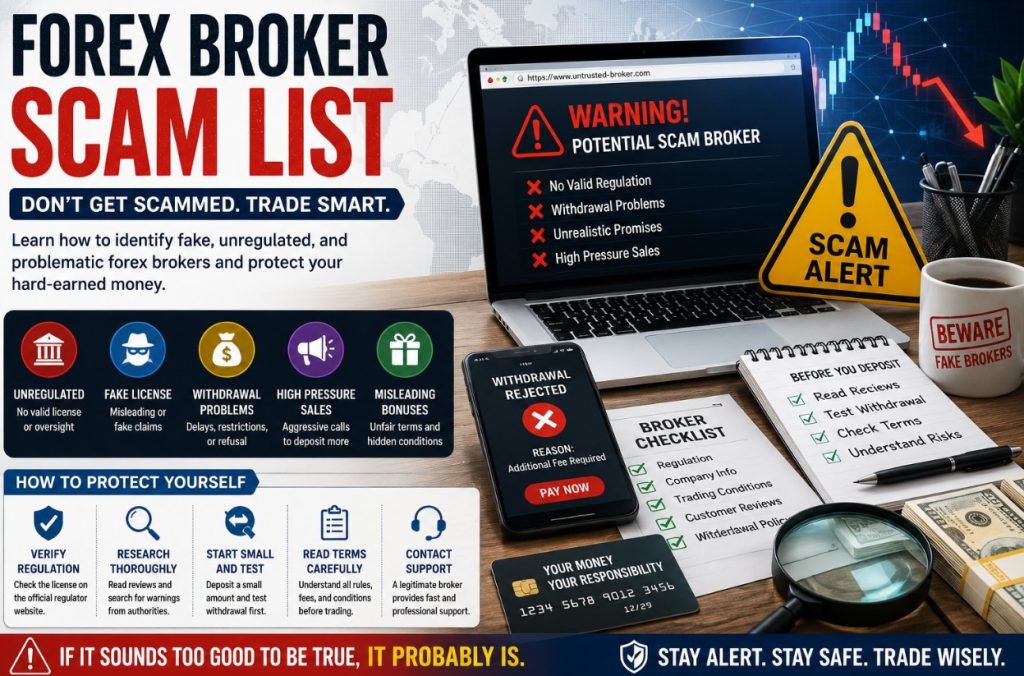
Forex Broker Scam List: How to Identify Fake, Unregulated, and Problematic Brokers
The forex market has become increasingly accessible to traders around the world. With a smartphone, an internet connection, and a relatively small amount of capital, almost anyone can open a trading account with an international forex broker.
However, this accessibility also creates significant risks.
While many forex brokers operate legitimate businesses, some platforms may be unregulated, falsely claim to be licensed, make withdrawals difficult, or use aggressive sales tactics to encourage clients to deposit more money.
This is why many traders search for a Forex Broker Scam List before choosing a broker.
However, identifying a forex scam is not always simple.
A professional-looking website does not automatically prove that a broker is legitimate. A company may display regulatory logos, offer popular trading platforms, advertise attractive spreads, and maintain active social media accounts while still presenting risks to clients.
The safest approach is to conduct independent research before opening an account or depositing funds.
Important: A broker should not be labeled a “scam” solely because of negative online reviews or because it operates from an offshore jurisdiction. Serious allegations should be supported by official regulatory warnings, verifiable legal information, court documents, or documented evidence. A broker’s regulatory status and operating conditions may also change over time.
What Is a Forex Broker Scam?
A forex broker scam generally refers to a company or trading platform that uses deceptive, misleading, or fraudulent practices to obtain money from traders or investors.
Common warning signs may include:
- Fake regulatory claims.
- Unverifiable licenses.
- Guaranteed profit promises.
- Withdrawal problems.
- Pressure to deposit additional funds.
- Misleading bonus promotions.
- Unclear company ownership.
- Aggressive account managers.
- Unusual fees before withdrawals.
- Sudden account restrictions.
However, not every dispute between a trader and a broker automatically means that the broker is a scam.
Some complaints may involve:
- Account verification issues.
- Bonus terms and conditions.
- Trading rule violations.
- Technical problems.
- Payment processing delays.
- Disputes regarding trading conditions.
Therefore, traders should carefully distinguish between verified regulatory information and unverified online accusations.
Forex Broker Scam List: Warning Signs Traders Should Look For
Rather than relying only on random internet blacklists, traders should focus on the specific warning signs associated with potentially dangerous forex brokers.
1. Brokers Listed on Official Regulatory Warning Lists
One of the strongest warning signs is an official warning issued by a financial regulator.
Regulatory authorities may issue warnings against companies that:
- Offer financial services without authorization.
- Target residents without the required license.
- Use misleading regulatory information.
- Impersonate legitimate financial companies.
- Operate outside the scope of their authorization.
If a forex broker appears on an official warning list, potential clients should exercise extreme caution.
The most reliable way to verify this information is to search for the company directly on the official website of the relevant regulator.
Do not rely solely on screenshots, social media posts, or claims published by the broker itself.
2. Forex Brokers with Fake or Unverifiable Licenses
One of the most common problems in the online trading industry is the use of misleading regulatory claims.
A broker may display:
- A regulator logo.
- A license number.
- A regulatory certificate.
- A compliance badge.
However, these details may not always be genuine or relevant.
Before trusting a broker, verify:
- The legal company name.
- The license number.
- The official regulator.
- The license status.
- The activities permitted under the license.
- The countries where the broker is authorized to operate.
A company may have a real registration but still not be authorized to offer forex or CFD services.
This is why simply seeing the word “regulated” on a broker’s website is not enough.
How to Check If a Forex Broker Is Legitimate
Step 1: Identify the Legal Company
The brand name of a broker may be different from the actual legal entity operating the business.
A single brand may operate through several companies in different jurisdictions.
Before depositing money, find out:
- The legal company name.
- The registered address.
- The country of registration.
- The regulator responsible for supervision.
- The entity responsible for your trading account.
The company receiving your deposit is more important than the marketing brand displayed on the website.
Step 2: Verify the Broker’s License
Go directly to the official website of the regulator the broker claims to be licensed by.
Search for the broker’s:
- Legal company name.
- License number.
- Registration number.
Check whether:
- The license is active.
- The company name matches.
- The website domain matches the registered company.
- The company is authorized to provide forex or CFD services.
- The broker is allowed to serve clients in your country.
If the information does not match, treat the broker with caution.
Step 3: Search for Regulatory Warnings
Search for the broker on official sources such as:
- Investor warning lists.
- Unauthorized firm lists.
- Enforcement notices.
- Regulatory announcements.
A regulatory warning does not necessarily mean that every allegation against a company has been legally proven.
However, an official warning is an important signal that requires further investigation.
Step 4: Research Withdrawal Complaints
One of the most important areas to investigate is a broker’s withdrawal history.
Look for repeated reports involving:
- Delayed withdrawals.
- Unexplained account restrictions.
- Additional payment demands.
- Unresponsive customer support.
- Unexpected withdrawal fees.
A single negative review does not prove fraud.
However, a repeated pattern of similar complaints from independent users should not be ignored.
Common Forex Broker Scam Methods
The Deposit Pressure Scam
Some traders report being contacted by account managers who constantly encourage them to deposit more money.
Typical statements may include:
- “You need to deposit more to recover your losses.”
- “This is a limited-time opportunity.”
- “The market is about to move.”
- “You need more margin immediately.”
- “Our professional team can help guarantee your recovery.”
Pressure tactics are a major warning sign.
A legitimate financial decision should never be based solely on emotional pressure from a salesperson.
The Withdrawal Fee Scam
A trader may attempt to withdraw funds and then receive a message claiming that additional money must be paid first.
The requested payment may be described as:
- A tax.
- An account activation fee.
- A security deposit.
- An AML verification fee.
- A withdrawal insurance payment.
- An account unlocking fee.
Before sending more money, verify the request independently.
If the only solution offered is to send additional funds before receiving your existing balance, extreme caution is required.
The Fake Bonus Trap
Large bonuses are often used as a marketing tool to attract new traders.
Examples include:
- 100% deposit bonuses.
- 200% deposit bonuses.
- Large welcome bonuses.
- Cashback promotions.
- “Risk-free” trading campaigns.
The problem is often hidden in the terms and conditions.
Some bonuses may require extremely high trading volumes before funds can be withdrawn.
Always read the complete bonus terms before accepting any promotional offer.
Offshore Forex Brokers: Are They All Scams?
No.
Operating from an offshore jurisdiction does not automatically mean that a broker is fraudulent.
Many legitimate international financial companies operate through different jurisdictions.
However, traders should conduct additional due diligence when dealing with a broker that:
- Has limited corporate information.
- Does not clearly explain its legal entity.
- Provides unclear regulatory details.
- Uses multiple company names.
- Has no transparent ownership information.
- Frequently changes its domain or brand.
The key question is not simply:
“Is this broker offshore?”
The more important question is:
“Can the broker’s legal identity, regulatory status, and operating history be independently verified?”
Forex Broker Red Flags
The following warning signs should be taken seriously:
| Red Flag | Why It Matters |
|---|---|
| Guaranteed profits | No legitimate broker can guarantee trading profits |
| Fake or unverifiable license | The company may not be properly authorized |
| Repeated withdrawal complaints | May indicate operational or financial problems |
| Pressure to deposit more money | Potential aggressive sales tactics |
| Payment required before withdrawal | Serious warning sign |
| Unclear legal entity | Makes legal verification difficult |
| Extremely complex bonus terms | Funds may become difficult to withdraw |
| Fake regulatory logos | Possible misleading representation |
| No clear company address | Limited transparency |
| Sudden account restrictions | Requires further investigation |
How to Avoid Forex Broker Scams
1. Never Believe Guaranteed Profit Claims
Forex trading involves risk.
No broker, trading system, account manager, or investment platform can legitimately guarantee that you will make a specific profit.
Be extremely cautious with claims such as:
- “Guaranteed monthly income.”
- “No-loss forex strategy.”
- “100% guaranteed profits.”
- “Risk-free trading.”
- “Double your money.”
2. Verify the Broker Before Depositing
Before making a deposit, verify:
- Company registration.
- Regulatory status.
- License number.
- Trading conditions.
- Withdrawal procedures.
- Customer support.
- Company history.
Do not rush simply because a broker is offering a limited-time promotion.
3. Start with a Small Deposit
If a broker passes your initial research, consider starting with a small amount.
Test:
- Deposit processing.
- Trading execution.
- Customer service.
- Withdrawal procedures.
Do not immediately transfer your entire trading capital to a broker you have never used before.
4. Do Not Let an Account Manager Control Your Decisions
You should always maintain control over:
- Your deposit.
- Your trading strategy.
- Your position size.
- Your risk management.
- Your withdrawal decisions.
If someone is constantly pressuring you to deposit more money, consider it a serious warning sign.
What Should You Do If You Have Been Scammed by a Forex Broker?
If you believe you may have been defrauded, act quickly.
Save All Evidence
Keep copies of:
- Emails.
- Chat messages.
- Deposit receipts.
- Withdrawal requests.
- Trading account screenshots.
- Bank transaction records.
- Cryptocurrency transaction IDs.
- Names and contact details of representatives.
Do not delete important communications.
Stop Sending Additional Money
Some victims lose even more money because they continue paying additional fees in the hope of recovering their original deposit.
Before sending additional funds, seek independent verification.
Contact Your Payment Provider
Depending on the payment method, contact:
- Your bank.
- Your card issuer.
- Your payment provider.
Ask what dispute or recovery procedures may be available.
There is no guarantee that funds can be recovered, but acting quickly may be important.
Report the Company to the Relevant Authorities
If the company claims to be regulated, contact the relevant regulator using independently verified official contact details.
Do not rely only on contact information supplied by the broker.
Frequently Asked Questions About Forex Broker Scams
What is a Forex Broker Scam List?
A Forex Broker Scam List generally refers to lists, warnings, and reports about forex brokers that may be unregulated, unauthorized, fraudulent, or associated with serious complaints.
However, traders should verify every claim through official regulatory sources because a broker’s status can change over time.
How can I check if a forex broker is legitimate?
Check the broker’s legal company name, verify its license directly through the official regulator’s database, review regulatory warnings, investigate withdrawal complaints, and carefully read the broker’s terms and conditions.
Is an offshore forex broker automatically a scam?
No. Offshore status alone does not prove that a broker is fraudulent. However, traders should carefully verify the broker’s legal identity, regulatory status, ownership, and operating history.
Can a regulated forex broker still have problems?
Yes. Regulation does not guarantee that a trader will never experience disputes, losses, technical problems, or poor service.
However, regulation may provide a formal framework for supervision and complaints, depending on the jurisdiction and applicable rules.
What is the biggest warning sign of a forex scam?
One of the most serious warning signs is being asked to send additional money before an existing balance can be withdrawn, especially when the reason is unclear or cannot be independently verified.
Are negative reviews enough to prove that a broker is a scam?
No. Negative reviews alone are not conclusive proof.
Traders should look for patterns, official regulatory warnings, verified legal information, and documented evidence.
Should I deposit more money to recover trading losses?
You should never deposit additional money simply because someone pressures you to recover previous losses.
Any additional investment should be based on your own independent decision and risk assessment.
Can I recover money lost to a forex scam?
Recovery depends on many factors, including the payment method, the time that has passed, the identity of the company, and the applicable laws.
Contact your bank, payment provider, and relevant authorities as soon as possible.
Final Verdict: Research Before You Deposit
The forex industry provides access to global financial markets, but traders must also recognize the risks associated with fraudulent and problematic trading platforms.
A professional website does not guarantee that a broker is safe.
A high leverage offer does not prove that a broker is trustworthy.
A regulatory logo does not automatically prove that the license is genuine.
Before opening a trading account, always verify:
- The legal company behind the broker.
- The authenticity of its license.
- Its regulatory status.
- Its withdrawal reputation.
- Its terms and conditions.
- Its history of complaints and warnings.
The best protection against a forex broker scam is independent research.
Never send money to a broker that you cannot independently verify.
This article is intended for educational and informational purposes only. Regulatory status, licensing information, company ownership, and operating conditions may change over time. Traders should conduct their own due diligence and verify the latest information through official regulatory sources before making any financial decision.
Frequently Asked Questions About Forex Broker Scams
What is a Forex Broker Scam List?
A Forex Broker Scam List generally refers to lists, warnings, and reports about forex brokers that may be unregulated, unauthorized, fraudulent, or associated with serious complaints. Traders should verify every claim through official regulatory sources.
How can I check if a forex broker is legitimate?
Check the broker’s legal company name, verify its license directly through the official regulator’s database, review regulatory warnings, investigate withdrawal complaints, and carefully read the broker’s terms and conditions.
Is an offshore forex broker automatically a scam?
No. Offshore status alone does not prove that a broker is fraudulent. Traders should verify the broker’s legal identity, regulatory status, ownership, and operating history.
Can a regulated forex broker still have problems?
Yes. Regulation does not guarantee that traders will never experience disputes, losses, technical problems, or poor service. However, regulation may provide a formal framework for supervision and complaints depending on the jurisdiction.
What is the biggest warning sign of a forex scam?
One of the most serious warning signs is being asked to send additional money before an existing balance can be withdrawn, especially when the reason is unclear or cannot be independently verified.
Are negative reviews enough to prove that a broker is a scam?
No. Negative reviews alone are not conclusive proof. Traders should look for patterns, official regulatory warnings, verified legal information, and documented evidence.
Should I deposit more money to recover trading losses?
You should never deposit additional money simply because someone pressures you to recover previous losses. Any additional investment should be based on your own independent decision and risk assessment.
Can I recover money lost to a forex scam?
Recovery depends on factors such as the payment method, the time that has passed, the identity of the company, and applicable laws. Contact your bank, payment provider, and relevant authorities as soon as possible.
Some links are affiliate links. Our editorial opinions remain independent.