Exness Cent Account Review
Exness Cent Account Review: A Practical Guide to Trading with Smaller Exposure For many new traders, the biggest challenge is not finding a trading strategy. It is managing the financial pressure that comes with trading a standard account. Even a small market movement can feel significant when the position size is too large relative to […]
 Mr. JoezJuly 19, 2026 · Updated when material facts change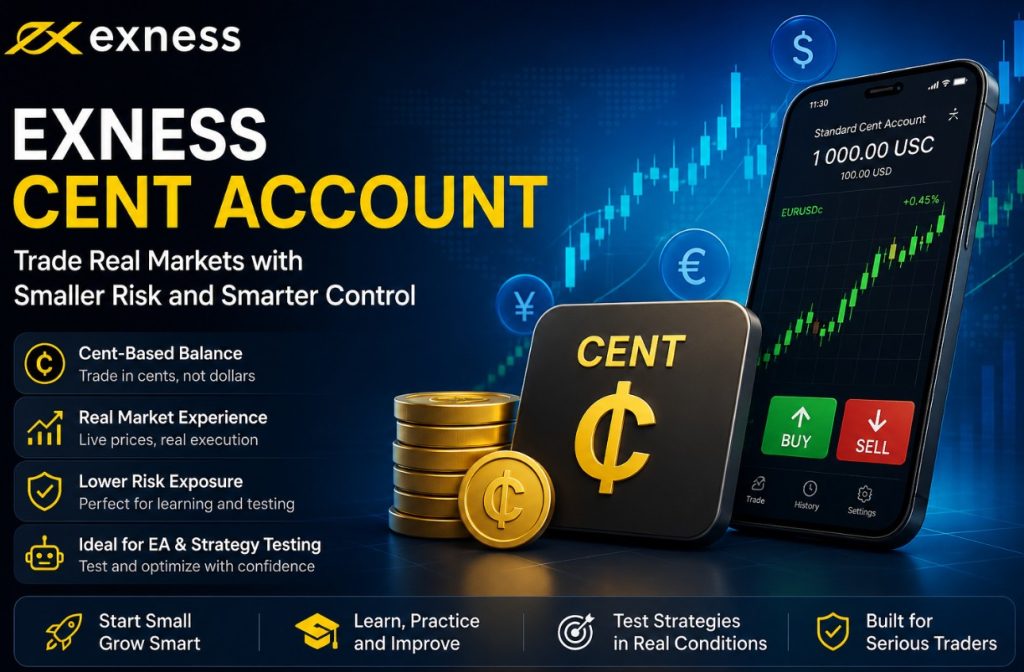
Exness Cent Account Review: A Practical Guide to Trading with Smaller Exposure
For many new traders, the biggest challenge is not finding a trading strategy. It is managing the financial pressure that comes with trading a standard account. Even a small market movement can feel significant when the position size is too large relative to the account balance.
This is where the Exness Standard Cent account can become an interesting option. Instead of displaying the account balance in regular currency units, the account operates using cent-based currencies and cent lots. This allows traders to work with much smaller trading exposure while still participating in live market conditions.
The Exness Cent account may be suitable for beginners, traders testing a new strategy, and experienced users who want to evaluate an Expert Advisor or automated trading system with lower financial exposure.
But how exactly does the account work, and is it genuinely useful for modern traders?
What Is the Exness Cent Account?
The Exness Cent account is officially known as the Standard Cent account. It is a trading account designed around cent lots rather than standard lots.
One cent lot represents 100,000 cents, equivalent to 1,000 units of the account’s base currency. In comparison, one standard lot represents 100,000 units of the base currency. As a result, one cent lot is equivalent to approximately 0.01 standard lot.
This structure gives traders a different way to manage position sizes.
For example, a deposit of $10 may appear as 1,000 USC in the account balance. The money has not magically increased in value; the account simply displays the balance in cents. This is an important distinction for beginners because the larger numerical balance can sometimes create a false perception of having more money than they actually deposited.
The main benefit is that trading volume is also measured in cent lots, allowing positions to be opened with smaller effective exposure compared with a conventional standard account.
According to Exness, the Standard Cent account uses market execution, does not charge trading commissions, and offers spreads from 0.3 pips.
How Does the Exness Cent Account Work?
The concept is relatively simple.
Suppose a trader deposits:
- $5 → 500 USC
- $10 → 1,000 USC
- $50 → 5,000 USC
- $100 → 10,000 USC
The displayed balance is converted into cents, but the real monetary value remains the same.
The account uses the suffix “-c” for its trading instruments. For example, a currency pair may appear with a cent-account symbol such as EURUSDc.
This is important because traders should not assume that a 1.00 cent lot is the same as a 1.00 standard lot. The volume structure is specifically designed to provide smaller exposure.
The minimum position volume is listed as 0.01 cent lots. Exness also states that the Standard Cent account can support leverage of up to 1:Unlimited, subject to applicable conditions and eligibility requirements.
High leverage, however, should not be confused with low risk. Leverage can reduce the margin required to open a trade, but it does not eliminate losses. The size of the position, market volatility, and the trading strategy remain the most important factors affecting account risk.
Exness Cent Account Trading Conditions
One of the reasons the account attracts attention is its relatively straightforward trading structure.
The main features include:
- No minimum initial deposit requirement from Exness, although the actual minimum may depend on the payment method and geographical location.
- Spreads from 0.3 pips.
- No trading commission.
- Market execution.
- Hedged margin of 0%.
- Margin call at 60%.
- Stop out at 0%.
- Maximum leverage of up to 1:Unlimited, depending on eligibility and regional restrictions.
- Minimum trading volume of 0.01 cent lots.
The account currently provides access to a selection of instruments, including currency pairs, metals, and selected cryptocurrencies. Examples include EURUSDc, GBPUSDc, USDJPYc, XAUUSDc, XAGUSDc, and BTCUSDc on MT5, although the available instruments can vary depending on the trading platform and applicable account conditions.
The availability of instruments should always be checked directly inside the trader’s Personal Area or trading platform because account specifications and regional availability may change.
Why Traders Use a Cent Account
The most obvious use case is starting with a smaller financial commitment. However, the account can be useful for more than just beginners.
1. A Bridge Between Demo and Live Trading
Demo trading is useful for learning platform functions and testing basic strategies. However, demo trading does not fully reproduce the emotional pressure associated with real money.
Even a small live account can change a trader’s behavior. The fear of losing, the temptation to close a profitable trade too early, and the tendency to overtrade can all become more noticeable.
A cent account provides an intermediate step between a demo environment and a larger live account. Traders can experience real market execution and real financial consequences while keeping the potential monetary exposure relatively small.
This makes it particularly useful for traders who have completed their initial demo testing but are not yet comfortable moving directly to a standard-size live account.
2. Testing Expert Advisors and Automated Strategies
The Exness Cent account can also be useful for testing automated trading systems.
An Expert Advisor may perform well during historical backtesting but behave differently in a live market. Real-time spread changes, execution conditions, market gaps, volatility, and trading server conditions can all affect the result.
A cent account allows a trader to evaluate an EA in a live environment with a smaller financial exposure than would typically be required on a conventional account.
This does not mean that a cent account can eliminate the risk of an EA. A poorly designed robot can still lose money. Instead, the account can serve as a practical testing environment before increasing the account balance or position size.
For algorithmic traders, this can be especially useful when testing:
- New Expert Advisors
- Grid systems
- Trend-following systems
- Scalping algorithms
- Automated risk-management models
- Copy trading configurations
- New trading parameters
The key principle is to test the strategy under realistic market conditions before increasing the financial commitment.
3. Testing New Trading Methods
A strategy can look attractive on paper but behave differently when exposed to real market conditions.
A trader may want to test a new indicator combination, a new entry model, a different stop-loss approach, or an alternative money-management method.
Using a cent account can provide a lower-cost testing environment. This can be particularly useful for traders experimenting with strategies that have not yet been fully validated.
However, “lower cost” does not mean “risk-free.” A strategy that loses consistently will still lose money. The advantage is that the monetary impact may be smaller when the position sizing is properly controlled.
Is the Exness Cent Account Suitable for Beginners?
For many beginners, it can be a suitable starting point because the account structure is designed for smaller trading exposure.
The lower barrier to entry can make it easier for a new trader to focus on learning important fundamentals such as:
- How spreads affect entries and exits
- How stop-loss orders work
- How margin is calculated
- How market volatility affects floating profit and loss
- How trading psychology influences decision-making
Instead of immediately focusing on making large profits, a beginner can focus on understanding the mechanics of trading.
This is arguably one of the most important benefits of a cent account. New traders often concentrate too much on profit targets and not enough on risk control.
A small account can be used to develop better habits before larger capital is placed at risk.
Exness Cent Account vs Standard Account
The Standard Cent account and the regular Standard account are both categorized as standard trading accounts, but they serve different purposes.
The Cent account is designed around cent lots and smaller effective exposure. The regular Standard account uses conventional trading volumes and offers a broader range of instruments.
According to Exness, the Standard account provides access to forex, metals, cryptocurrencies, energies, stocks, and indices, while the Standard Cent account has a more limited instrument selection.
A trader might therefore consider the Cent account when:
- Starting with a smaller balance
- Learning live trading
- Testing an EA
- Testing a new strategy
- Practicing money management
A regular Standard account may become more suitable when:
- The trader has more experience
- Larger trading volume is required
- A wider range of instruments is needed
- The trader wants to operate with conventional lot sizes
The right account ultimately depends on the trader’s objectives and risk tolerance.

Important Risk Considerations
One of the biggest mistakes beginners make with cent accounts is assuming that a small account automatically means low risk.
The account balance may be displayed in cents, but the trader can still make poor trading decisions.
For example, opening too many positions, using excessive leverage, applying aggressive averaging, or running an untested Expert Advisor can still lead to significant losses relative to the actual deposited capital.
The account should therefore be viewed as a tool for managing exposure, not as a way to avoid risk.
Traders should pay particular attention to:
Position Size
The position size should be calculated according to the account balance and strategy risk.
Maximum Drawdown
A strategy may experience a series of losing trades before recovering. Understanding the historical and expected drawdown is essential.
Leverage
High leverage can make it possible to open larger positions with less margin. However, larger positions can also increase the speed at which an account loses money.
Strategy Testing
A strategy should ideally be tested using historical data, demo trading, and carefully controlled live conditions.
Broker and Regional Conditions
The exact trading conditions available to a client may depend on the registered Exness entity, country of residence, platform, and payment method.
How to Open an Exness Cent Account
The general process is straightforward.
First, a trader needs to create or access an Exness Personal Area. From there, the user can open a new trading account and select the available account type.
The process generally involves:
- Log in to the Exness Personal Area.
- Go to the account section.
- Select the option to open a new trading account.
- Choose the Standard Cent account if it is available for the registered region.
- Select the trading platform.
- Choose the available account currency.
- Set the required trading password and account details.
- Complete the account creation process.
Exness states that multiple trading accounts can be created from the Personal Area, subject to applicable limits. The account type and allocated trading server cannot be changed after creation, so traders who want a different account type generally need to open a new trading account.
Which Account Currency Does the Cent Account Use?
Unlike regular Exness accounts that may support many traditional currencies, the Standard Cent account uses cent-based account currencies such as USC, EUC, GBC, CHC, AUC, and CAC.
The exact available currency depends on the account and applicable conditions. Exness also notes that the account currency cannot be changed after the trading account has been created.
This is another reason why traders should carefully review the account details before opening the account.
Final Verdict: Is an Exness Cent Account Worth Considering?
The Exness Standard Cent account is not simply a smaller version of a regular trading account. Its cent-lot structure makes it particularly useful for traders who want to participate in live markets with smaller effective position sizes.
For beginners, it can provide a practical transition from demo trading to live trading.
For strategy developers, it can be used as a controlled environment for testing new ideas.
For automated traders, it may provide a useful live-testing stage before increasing capital allocation to a larger account.
The most important point is that the account should be used with realistic expectations. A cent account does not guarantee profits, remove market risk, or make an aggressive strategy safe.
Its real advantage is flexibility. Traders can begin with smaller exposure, observe how their strategy behaves in live conditions, and gradually decide whether the system is ready for larger capital.
For traders who prioritize testing, learning, and controlled exposure, the Exness Cent account can be a practical tool within a broader trading plan.
As with any leveraged trading product, traders should carefully review the current conditions available in their region and understand the risks before opening and funding an account.
Some links are affiliate links. Our editorial opinions remain independent.